Showing posts with label For Developers. Show all posts

Wednesday, July 8, 2026

Grok 4.5 Outperforms GPT-5.5 - at a Fraction of the Cost


I have a Rust refactor I’ve been putting off for three weeks. It’s not a complex change — extract a shared module, update six call sites, make sure nothing breaks — but it’s the kind of task I keep kicking to tomorrow. I loaded Grok 4.5, described what I needed in two sentences, and it finished in under a minute. The code compiled on the first try.

That’s when I knew this model was different.

What Makes Grok 4.5 Different

Most AI models are built as general-purpose chatbots first, with coding as an afterthought. SpaceXAI took the opposite approach: they trained Grok 4.5 alongside Cursor — the AI coding editor that’s become a developer staple — and optimized it for multi-step software engineering from day one.

The training setup is equally unusual. Tens of thousands of NVIDIA GB300 GPUs running reinforcement learning that spans hundreds of thousands of programming tasks. The RL stack is designed for asynchronous training — the model can spend minutes or hours solving a complex engineering problem and keep learning from the result, even while the next batch of training is already running. That’s something most labs can’t do at this scale.

The One Benchmark Number That Matters

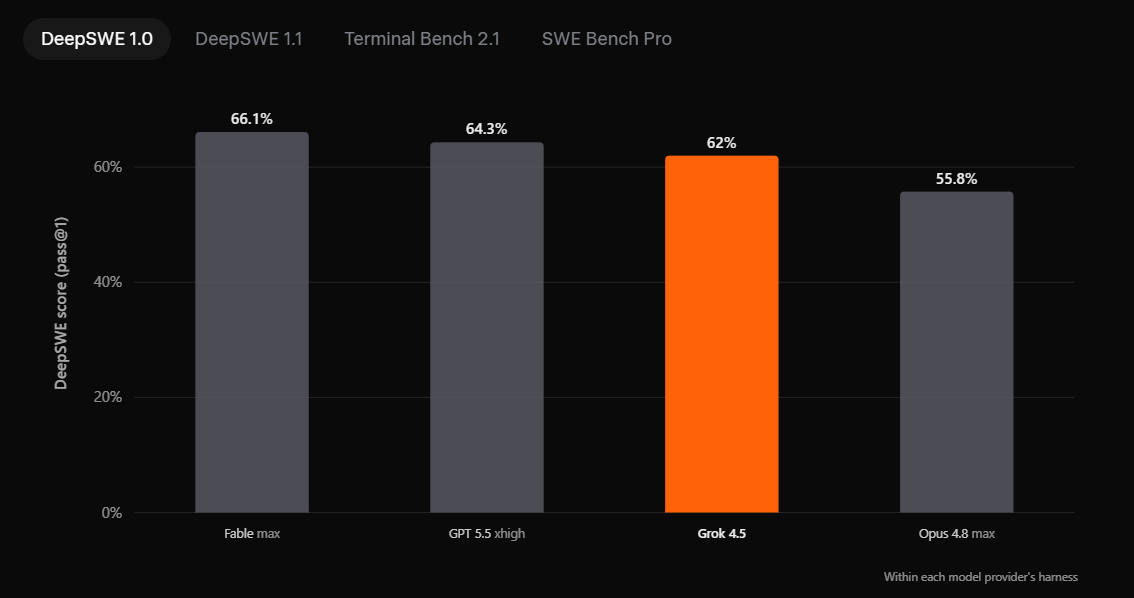
There are four major coding benchmarks where Grok 4.5 competes with GPT-5.5, Opus 4.8, and Fable. The scores are close across the board — Grok 4.5 lands at 62% on DeepSWE 1.0 and 83.3% on Terminal Bench 2.1, within striking distance of every leading model.

But the number that actually matters isn’t a percentage. It’s efficiency. On SWE Bench Pro, Grok 4.5 uses an average of 15,954 output tokens to resolve a task. Opus 4.8 uses 67,020 tokens for the same work. That’s 4.2× fewer tokens. In practice: Grok 4.5 gets the same result with less than a quarter of the output. Less rambling, more solving.

Built for Real Engineering

I’ve watched Grok 4.5 build a full solar system simulation with Three.js from a single prompt — adjustable time acceleration, orbital mechanics, modern HUD. The code was clean and production-ready.

If you work in Rust, C, or C++, the model handles those as naturally as Python. It was trained on datasets spanning coding, science, engineering, and math. The result isn’t just a model that writes code — it’s one that understands the engineering context around the code.

Faster Than Flash Models

Grok 4.5 serves at 80 tokens per second. Most reasoning models of this caliber run at 15–30 TPS. The difference is tangible: you paste a 500-line function, hit enter, and the refactor appears before your cursor stops blinking.

The pricing is equally aggressive: $2 per million input tokens, $6 per million output. Combined with 2× token efficiency over comparable models, the effective cost per task is dramatically lower. A typical SWE Bench Pro task costs about $0.10 on Grok 4.5 versus $0.40 on Opus 4.8.

It Does Spreadsheets and Presentations Too

Grok 4.5 isn’t a one-trick model. It scored #1 on Harvey’s Legal Agent Benchmark. In Grok Build, it can build complex Excel models with multi-sheet formulas and web research. It uses native PowerPoint shapes for diagrams and writes clear prose in Word. I watched it draft a five-slide quarterly business review from scratch — sections, layout, everything.

FAQ

How does Grok 4.5 stack up against GPT-5.5 and Opus 4.8?

It beats Opus 4.8 on every major coding benchmark and trades blows with GPT-5.5 — within 1–2 percentage points on most tests. The real advantage is efficiency: it uses 4.2× fewer tokens than Opus 4.8 for the same results.

Can I use Grok 4.5 in Cursor right now?

Yes — it’s available in Cursor on all plans today. Also in Grok Build and through the API. There’s free usage for a limited time, so no reason not to try it.

Is Grok 4.5 available in Europe?

Not yet. EU availability is expected in mid-July 2026. SpaceXAI confirmed no EU access through any of their products or the API until then.

How much does it actually cost?

$2 per million input tokens, $6 per million output tokens. With the 2× token efficiency, the real cost per task is roughly a quarter of what you’d pay on Opus 4.8.

What hardware was it trained on?

Tens of thousands of NVIDIA GB300 GPUs, with heavy investment in data filtering and deduplication. The RL training stack is designed for highly asynchronous operation — model rollouts can run for hours while training continues in parallel.

Try It on Something Real

Grok 4.5 is available right now at x.ai/cli. Grab an API key, pick an engineering task you’ve been avoiding — the Rust refactor, that SQL query that needs rewriting, the Python script that’s been running slow — and see how it handles it. There’s free usage through the end of July, so the only cost is five minutes of your time.

I found my Rust refactor in under a minute. I’m not switching back.


Tuesday, June 30, 2026

Claude Sonnet 5 Just Made Opus Look Expensive


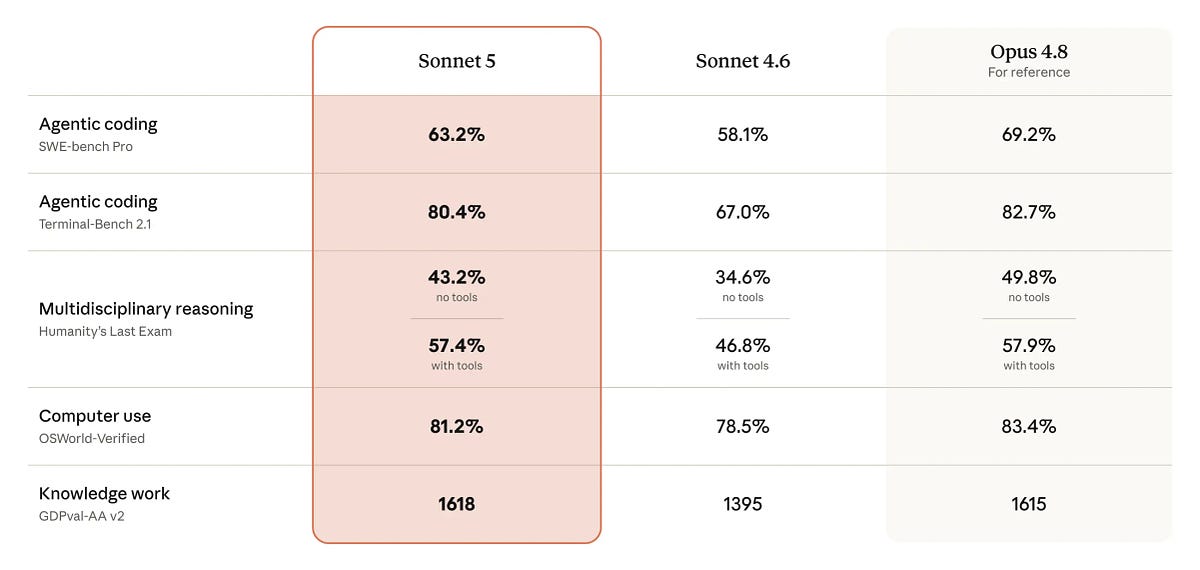
If you’re a developer who watched Opus 4.8 pull ahead on agentic tasks over the last few months, Sonnet 5 is the model that brings those capabilities back to a price that makes sense for daily API calls. Announced yesterday by Anthropic, Claude Sonnet 5 closes the gap with Opus 4.8 across the dimensions that matter most for shipping real software: reasoning, tool use, coding, and autonomous multi-step execution — at roughly half the cost.

What Makes Sonnet 5 Different

Sonnet 5 is the most agentic Sonnet model Anthropic has released. It can make plans, use browsers and terminals, and run autonomously at a level that previously required Opus-class models. On BrowseComp, a benchmark for agentic search, Sonnet 5 at high effort levels matches Opus 4.8 performance while staying on a much lower cost curve. On OSWorld-Verified, a computer-use evaluation, the story is similar.

The improvement over Sonnet 4.6 is substantial across the board. Anthropic published benchmarks show gains in reasoning, tool use, coding, and knowledge work — the four pillars of agentic development. For developers, this means the model you reach for by default in Free and Pro plans can now handle tasks that used to be Opus-only.

Pricing That Actually Moves the Needle

The pricing story is where Sonnet 5 gets interesting for anyone paying API bills. Through August 31, 2026, introductory pricing sits at $2 per million input tokens and $10 per million output tokens. After that, standard pricing kicks in at $3 and $15 respectively. Compare that to Opus 4.8 at $5 and $25, and the math becomes straightforward.

There is one tradeoff. Sonnet 5 uses an updated tokenizer that maps the same input to roughly 1.0 to 1.35 times more tokens depending on content type, similar to the change Anthropic introduced with Opus 4.7. Anthropic set the introductory pricing to be roughly cost-neutral during the transition, but teams running high-volume pipelines should benchmark their actual token counts before assuming the per-token savings translate directly.

The effort parameter is worth understanding. Sonnet 5 can operate at different effort levels — low, medium, high, and extra high — letting you pay for capability only when you need it. A quick lint check runs at low effort; a full codebase refactor runs at high. The cost-performance curves published by Anthropic show that medium effort on Sonnet 5 already beats Sonnet 4.6 at any effort level, and high effort comes close to Opus 4.8 on many tasks.

What Early Access Partners Found

The early access feedback tells a consistent story: Sonnet 5 finishes tasks where prior Sonnet models stopped short. Zimu Li at Canva described it handling multi-step software engineering work across messy technical contexts. The Rust engineer Neel Chotai reported that Sonnet 5, unprompted, wrote a reproducing test, implemented the fix, then stashed it to confirm the bug came back without the change — all in a single pass.

Dominic Elm, a founding engineer, noted that Sonnet 5 shines on brownfield code — race conditions, hidden tests, the parts nobody wants to touch. For Lovable co-founder Fabian Hedin, the model ability to refuse unsafe requests was just as important as its ability to build. At ClickHouse, Ryadh Dahimene reported that Sonnet 5 reasons in tighter steps and gets users to answers faster.

Safety That Scales with Agency

Giving a model more autonomy raises the stakes on safety. Anthropic pre-deployment evaluations found that Sonnet 5 is better than Sonnet 4.6 at refusing malicious requests, resisting prompt injection hijack attempts, and avoiding hallucination and sycophancy. Its overall rate of misaligned behavior on automated auditing is lower than its predecessor.

On cybersecurity, Anthropic chose restraint. Sonnet 5 was never able to develop a working exploit for Firefox vulnerabilities in testing — something Opus 4.8 and Mythos 5 both managed. Cyber safeguards are enabled by default, and the model is part of the Cyber Verification Program for organizations that need reduced guardrails.

How to Try Sonnet 5 Today

Sonnet 5 is the default model for Free and Pro plans starting today. It is also available to Max, Team, and Enterprise users. For developers, it is accessible through Claude Code and the Claude Platform API using the model ID claude-sonnet-5. Anthropic has raised rate limits across Chat, Cowork, Claude Code, and the Platform to accommodate the higher token usage of higher effort levels.

FAQ

How does Claude Sonnet 5 compare to Opus 4.8 for coding tasks?

Sonnet 5 at high and extra-high effort levels comes close to Opus 4.8 on coding benchmarks and real-world pull requests. Early access partners reported it carrying complex multi-file changes through to tested, verified results. For most daily development work, Sonnet 5 is sufficient — reach for Opus 4.8 only for the hardest problems where you need maximum capability regardless of cost.

What is the effort parameter and how does it affect cost?

The effort parameter lets you choose how much inference compute the model spends on a task. Low effort is cheapest and fastest, suitable for simple lookups or linting. High and extra-high effort spend more tokens to produce better results on complex tasks like code review or architectural analysis. You pay per token, so higher effort costs more — but only when you need it.

Is Sonnet 5 available in Claude Code and the API?

Yes. Sonnet 5 is available in Claude Code and through the Claude Platform API. The model ID is claude-sonnet-5. Rate limits have been increased across all tiers to support the higher token usage from effort-level selection.

Does the new tokenizer make Sonnet 5 more expensive in practice?

The updated tokenizer maps the same input to 1.0 to 1.35 times more tokens depending on content type. Through August 31, introductory pricing is set to be roughly cost-neutral versus Sonnet 4.6. After that, the standard $3/$15 pricing still represents a meaningful improvement in capability per dollar, especially at medium effort levels.

How safe is Sonnet 5 for autonomous agent workflows?

Sonnet 5 performs better than Sonnet 4.6 on every safety metric Anthropic measures: lower hallucination, lower sycophancy, better refusal of malicious requests, and better resistance to prompt injection. Cyber safeguards are enabled by default. If you are building agents that operate on user behalf, Sonnet 5 is the safest Sonnet yet for that use case.

Try Sonnet 5 Today and Decide for Yourself

If you are on a Free or Pro plan, Sonnet 5 is already the default — open Claude and see the difference. If you are building on the API, spin up claude-sonnet-5 at the introductory pricing and run it against your test suite. The model costs less than Opus, handles more than any Sonnet before it, and the only way to know if it works for your specific workload is to try it. Set aside 30 minutes this week to run your most painful agentic task through Sonnet 5 and compare the result.