I have a Rust refactor I’ve been putting off for three weeks. It’s not a complex change — extract a shared module, update six call sites, make sure nothing breaks — but it’s the kind of task I keep kicking to tomorrow. I loaded Grok 4.5, described what I needed in two sentences, and it finished in under a minute. The code compiled on the first try.
That’s when I knew this model was different.
What Makes Grok 4.5 Different
Most AI models are built as general-purpose chatbots first, with coding as an afterthought. SpaceXAI took the opposite approach: they trained Grok 4.5 alongside Cursor — the AI coding editor that’s become a developer staple — and optimized it for multi-step software engineering from day one.
The training setup is equally unusual. Tens of thousands of NVIDIA GB300 GPUs running reinforcement learning that spans hundreds of thousands of programming tasks. The RL stack is designed for asynchronous training — the model can spend minutes or hours solving a complex engineering problem and keep learning from the result, even while the next batch of training is already running. That’s something most labs can’t do at this scale.
The One Benchmark Number That Matters
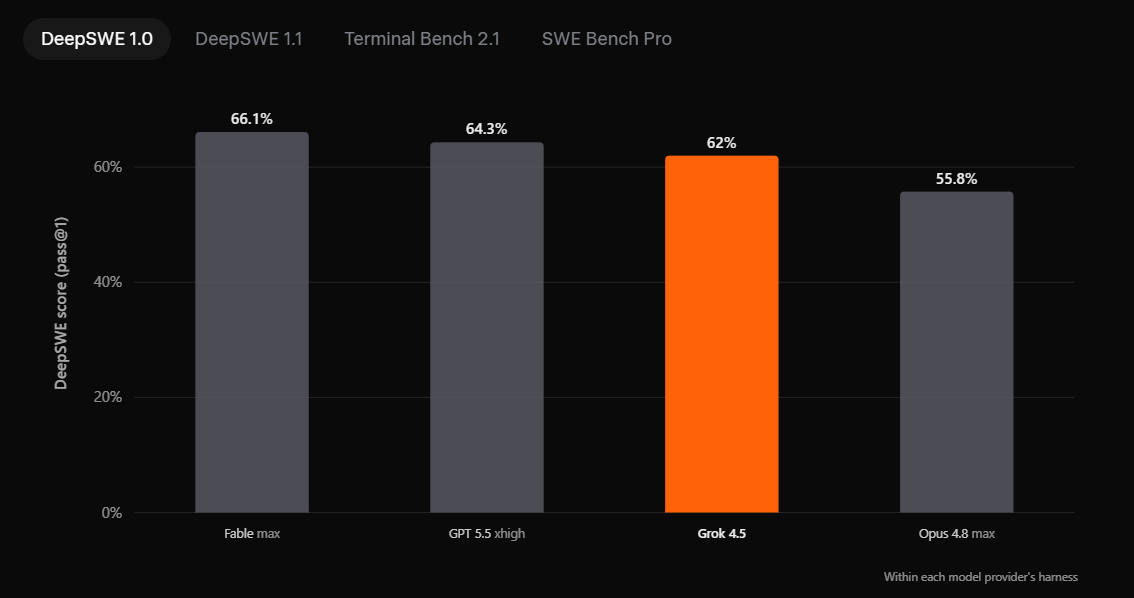
There are four major coding benchmarks where Grok 4.5 competes with GPT-5.5, Opus 4.8, and Fable. The scores are close across the board — Grok 4.5 lands at 62% on DeepSWE 1.0 and 83.3% on Terminal Bench 2.1, within striking distance of every leading model.
But the number that actually matters isn’t a percentage. It’s efficiency. On SWE Bench Pro, Grok 4.5 uses an average of 15,954 output tokens to resolve a task. Opus 4.8 uses 67,020 tokens for the same work. That’s 4.2× fewer tokens. In practice: Grok 4.5 gets the same result with less than a quarter of the output. Less rambling, more solving.
Built for Real Engineering
I’ve watched Grok 4.5 build a full solar system simulation with Three.js from a single prompt — adjustable time acceleration, orbital mechanics, modern HUD. The code was clean and production-ready.
If you work in Rust, C, or C++, the model handles those as naturally as Python. It was trained on datasets spanning coding, science, engineering, and math. The result isn’t just a model that writes code — it’s one that understands the engineering context around the code.
Faster Than Flash Models
Grok 4.5 serves at 80 tokens per second. Most reasoning models of this caliber run at 15–30 TPS. The difference is tangible: you paste a 500-line function, hit enter, and the refactor appears before your cursor stops blinking.
The pricing is equally aggressive: $2 per million input tokens, $6 per million output. Combined with 2× token efficiency over comparable models, the effective cost per task is dramatically lower. A typical SWE Bench Pro task costs about $0.10 on Grok 4.5 versus $0.40 on Opus 4.8.
It Does Spreadsheets and Presentations Too
Grok 4.5 isn’t a one-trick model. It scored #1 on Harvey’s Legal Agent Benchmark. In Grok Build, it can build complex Excel models with multi-sheet formulas and web research. It uses native PowerPoint shapes for diagrams and writes clear prose in Word. I watched it draft a five-slide quarterly business review from scratch — sections, layout, everything.
FAQ
How does Grok 4.5 stack up against GPT-5.5 and Opus 4.8?
It beats Opus 4.8 on every major coding benchmark and trades blows with GPT-5.5 — within 1–2 percentage points on most tests. The real advantage is efficiency: it uses 4.2× fewer tokens than Opus 4.8 for the same results.
Can I use Grok 4.5 in Cursor right now?
Yes — it’s available in Cursor on all plans today. Also in Grok Build and through the API. There’s free usage for a limited time, so no reason not to try it.
Is Grok 4.5 available in Europe?
Not yet. EU availability is expected in mid-July 2026. SpaceXAI confirmed no EU access through any of their products or the API until then.
How much does it actually cost?
$2 per million input tokens, $6 per million output tokens. With the 2× token efficiency, the real cost per task is roughly a quarter of what you’d pay on Opus 4.8.
What hardware was it trained on?
Tens of thousands of NVIDIA GB300 GPUs, with heavy investment in data filtering and deduplication. The RL training stack is designed for highly asynchronous operation — model rollouts can run for hours while training continues in parallel.
Try It on Something Real
Grok 4.5 is available right now at x.ai/cli. Grab an API key, pick an engineering task you’ve been avoiding — the Rust refactor, that SQL query that needs rewriting, the Python script that’s been running slow — and see how it handles it. There’s free usage through the end of July, so the only cost is five minutes of your time.
I found my Rust refactor in under a minute. I’m not switching back.

No comments :
Post a Comment