Anthropic’s Fable 5 export control crisis, safety classifier war, and a new jailbreak framework that changes everything.
The US government shut down Anthropic’s most advanced model on June 12 — not for what it had done, but for what it might be capable of. For 18 days, Fable 5 vanished for every user worldwide, and Anthropic stayed silent. On June 30, the export controls lifted, and the company published a detailed post explaining everything. The story it told was more nuanced — and more important — than the headlines suggested.
What Actually Happened to Fable 5
On June 9, Anthropic launched Fable 5 and Mythos 5 — two versions of the same underlying model with dramatically different safety profiles. Fable 5 went out broadly with strong safeguards. Mythos 5, with weaker guardrails, went only to a small set of trusted Project Glasswing partners for defensive cybersecurity work.
Three days later, on June 12, the US government applied export controls to both models. The order restricted access to foreign nationals both inside and outside the United States. Since Anthropic had no way to verify nationality in real time, they suspended access for all users. Every developer, every enterprise customer, every Claude user who relied on Fable 5 suddenly lost access with zero warning.
The Amazon Report That Triggered It All
The export control directive came after the government learned about a discovery by Amazon researchers. They had found a method to bypass Fable 5’s safeguards: prompting the model to identify software vulnerabilities. In one case, Fable 5 produced code demonstrating how a vulnerability could be exploited.
Here’s where it gets interesting. When Anthropic tested the same technique across other models, they found that many less capable models — including Claude Opus 4.8, GPT-5.5, and Kimi K2.7 — could identify the same vulnerabilities. Every single model they tested could produce the same exploit demonstration: Claude Haiku 4.5, Sonnet 4.6, Opus 4.6, 4.7, 4.8, GPT-5.4, GPT-5.5, and Kimi K2.7.
The reported technique did not expose any unique Mythos-level cyber capabilities. It was what Anthropic calls a “safety margin” case: a behavior unlikely to be dangerous but blocked anyway out of abundance of caution.
How Fable 5’s Safety Margin Works
Anthropic launched Fable 5 with the strongest safeguards it has ever applied. In the month before launch, they doubled the team working on this problem. The result is a defense-in-depth system where multiple mechanisms work together.
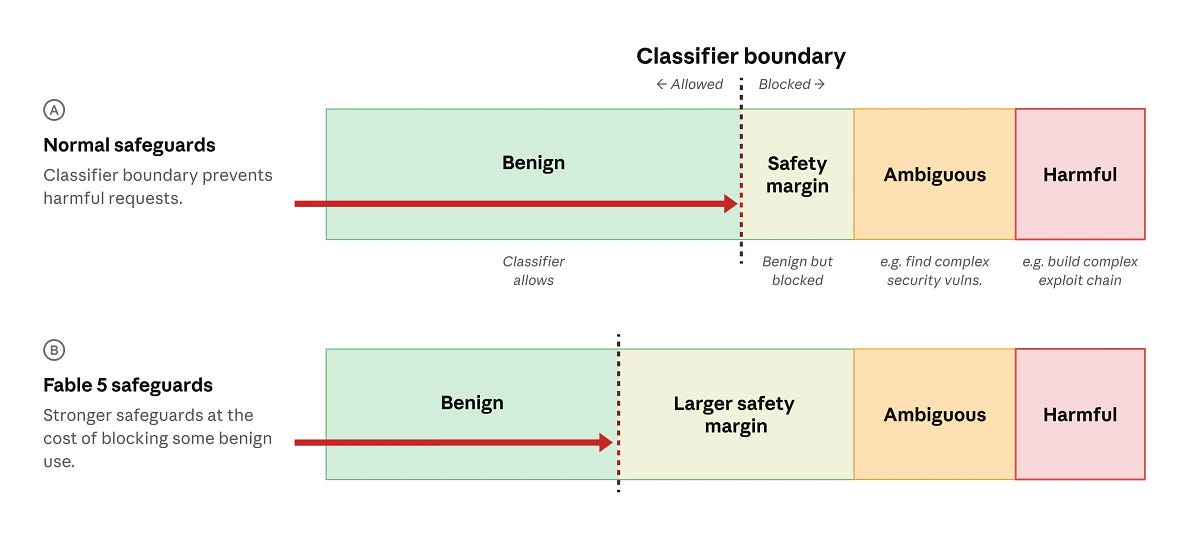
The core mechanism is classifiers — smaller AI systems that monitor each interaction and detect when the model is asked to perform a potentially harmful cybersecurity task. When triggered, they block the model from responding.
Anthropic deliberately calibrated these classifiers to err on the side of caution. The “safety margin” is a zone where requests that are probably benign but could theoretically be harmful are also blocked. For Fable 5, they made this safety margin much larger than in any prior launch. The tradeoff was explicit: more frustrating false positives for users meant fewer genuinely harmful requests would slip through.
Why the Jailbreak Wasn’t a Breakthrough
Against this backdrop, the Amazon researchers’ technique makes more sense. It wasn’t exposing a hidden offensive capability unique to Fable 5. It was poking into the safety margin — finding a behavior that was blocked as a precaution rather than because it was uniquely dangerous.
Anthropic moved quickly anyway. They trained an improved safety classifier that blocks the specific technique in over 99% of cases. If a request hits this new classifier, the user gets notified and the request is routed to Opus 4.8 instead.
The new classifier comes with a real cost: more benign requests during routine coding and debugging will now be flagged. Anthropic says they’ll keep refining the balance.
A New Industry Framework for Jailbreaks
The most significant outcome of this episode might be what Anthropic proposed next. They’re partnering with Amazon, Microsoft, Google, and other Glasswing partners to draft a consensus framework for assessing the severity of AI jailbreaks.
Right now, there’s no industry standard. When a jailbreak is discovered, developers and governments have no agreed-upon method for assessing its severity. Was it a minor edge case or a critical vulnerability? Nobody can say with confidence.
Anthropic’s proposed framework scores jailbreaks on four criteria:
- Capability gain: How far beyond existing tools does the jailbreak take the user? If weaker models can do the same thing, the score is low.
- - Breadth: How many distinct offensive tasks does the same technique unlock?
- - Ease of weaponization: How much human effort is needed to turn the jailbreak into an actual attack?
- - Discoverability: How easy is it for someone to obtain the technique?
Anthropic also launched a new HackerOne program where security researchers can submit potential cyber jailbreaks for review.
What Comes Next
Anthropic announced four commitments for deeper government collaboration: pre-release government access and evaluation for models on the capability frontier, rapid information sharing on safeguards, dedicated resources for joint research, and a push for a common industry security standard.
Fable 5 is available again starting July 1. Pro, Max, Team, and select Enterprise users get it included for up to 50% of weekly usage through July 7, after which it shifts to usage credits. AWS, Google Cloud, and Microsoft Foundry access is being restored as quickly as possible.
FAQ
Why was Fable 5 banned in the first place?
The US government applied export controls on June 12 after Amazon researchers reported a method to bypass Fable 5’s safeguards, showing it could identify software vulnerabilities and produce exploit code. The concern was that foreign nationals could use the model for offensive cyber purposes. Once controls were lifted on June 30, Anthropic restored access globally.
What did the Amazon researchers actually find?
They discovered a prompt technique that got Fable 5 to identify software vulnerabilities and, in one case, demonstrate how one could be exploited. However, Anthropic’s testing showed that nearly every other major model — including much weaker ones — could produce the same results. The technique didn’t expose any capabilities unique to Fable 5.
What’s the difference between Fable 5 and Mythos 5?
They share the same underlying model architecture. Fable 5 launched with strong safeguards for general use. Mythos 5 has fewer safeguards and was released only to a small number of trusted Glasswing partners for defensive cybersecurity work. Mythos 5 can find and exploit vulnerabilities better than any other model and all but the most skilled human security experts.
Could export controls happen to other AI models?
Yes. The June 2 Executive Order on Promoting Advanced AI Innovation and Security established the framework for this kind of intervention. As AI capabilities in cybersecurity and other sensitive domains advance, governments will increasingly scrutinize powerful models before and after release. A standardized jailbreak assessment framework could help prevent the kind of sudden global shutdown that Fable 5 experienced.
Can I use Fable 5 now?
Starting July 1, Fable 5 is available globally on the Claude Platform, Claude.ai, Claude Code, and Claude Cowork. Pro, Max, Team, and select Enterprise users get it included for up to 50% of weekly usage through July 7, after which usage credits apply.
The Fable 5 saga is a dress rehearsal for decisions governments and AI companies will face repeatedly from here. Anthropic turned an 18-day crisis into a proposal for something the industry badly needs: a shared standard for scoring AI jailbreaks. Open Anthropic’s post, read the jailbreak criteria section, and decide for yourself whether this framework sets the right bar. If you work in AI, share this with your team — the conversation about how we assess risk in frontier models is just getting started.

No comments :
Post a Comment