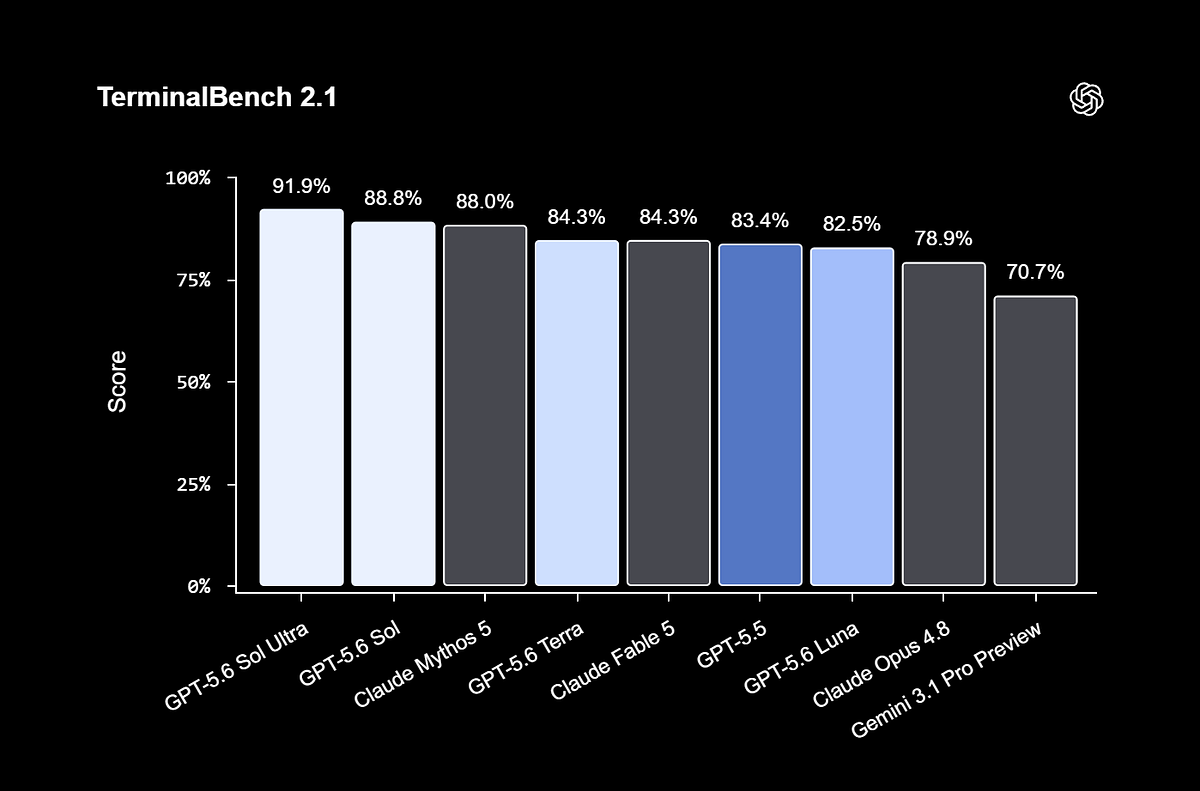
OpenAI announced GPT-5.6 Sol, a new reasoning model with two sibling tiers — Terra and Luna — but the naming change matters more than the benchmark numbers. The number (5.6) tracks the generation; Sol, Terra, and Luna are durable capability tiers that will evolve on their own cadence. That means developers now evaluate a model family rather than a single checkpoint, choosing across intelligence, speed, and cost.
The GPT-5.6 Family: Sol, Terra, and Luna
Sol is the flagship — OpenAI’s strongest model for agentic coding, biology, and cybersecurity workloads. Terra is positioned as a balanced model for everyday work, with competitive performance to GPT-5.5 at half the input price ($2.50 vs $5 per 1M tokens). Luna is the fast, affordable tier at $1 input / $6 output per 1M tokens, aimed at high-volume or latency-sensitive use cases.
The tier structure is new for OpenAI. Instead of releasing one model and obsoleting the last, the Sol/Terra/Luna names stay stable while the underlying checkpoints improve. If you build on Terra today and Terra v2 ships next quarter, your integration continues to work — the capability tier becomes the contract.
New Reasoning Modes: max and ultra
GPT-5.6 introduces two new reasoning modes. max reasoning effort gives Sol more time to reason deeply on complex tasks. ultra mode extends beyond single-agent reasoning by orchestrating subagents to parallelize work.
The results show up in benchmarks. Sol sets a new state of the art on Terminal-Bench 2.1, which tests command-line workflows requiring planning, iteration, and tool coordination. On GeneBench v1, Sol outperforms GPT-5.5 on long-horizon genomics analysis while using fewer tokens. On ExploitBench, Sol is competitive with Mythos Preview at roughly one-third the output tokens.
For developers building agentic workflows, ultra mode is the most interesting new capability. It shifts the model from a single reasoning pass to a multi-agent architecture — something most teams currently build themselves on top of the API. OpenAI is packaging it as a mode parameter.
Safety and the API: What Changes for Developers
GPT-5.6 Sol ships with what OpenAI calls its most robust safety stack to date. For developers, the observable effects are three: real-time content classifiers may pause generation for review, the model is trained to refuse prohibited cyber assistance even under jailbreak attempts, and account-level review can flag suspicious patterns across conversations.
During the preview, some legitimate requests — especially in dual-use areas like vulnerability research — may be blocked or delayed. OpenAI is explicit about this: the preview is as much about testing safeguard reliability for legitimate users as it is about constraining misuse.
OpenAI dedicated over 700,000 A100-equivalent GPU hours to automated red-teaming for this release, targeting universal jailbreaks that work across many contexts rather than narrow single-shot attacks.
Pricing, Prompt Caching, and the API
Per 1M tokens, Sol is $5 input / $30 output, Terra is $2.50 input / $15 output, and Luna is $1 input / $6 output. The preview starts with API and Codex access for select partners.
Prompt caching gets a meaningful update: explicit cache breakpoints and a 30-minute minimum cache life. Cache writes are billed at 1.25x the uncached input rate, while cache reads continue at the 90% discount. This makes long-context workflows — codebase analysis, multi-turn agent conversations, document processing — more predictable to budget.
FAQ
How does GPT-5.6 Sol compare to GPT-5.5 for coding?
Sol sets new state-of-the-art results on Terminal-Bench 2.1, which tests real command-line workflows with planning and tool use. Terra is competitive with GPT-5.5 at half the input price. For most production coding workflows, Terra likely offers the best cost-to-performance ratio.
When will GPT-5.6 models be available to all developers?
OpenAI is running a limited preview for select partners first. Broader API and ChatGPT availability is expected in the coming weeks. The U.S. government requested the phased rollout; OpenAI has stated this should not become the long-term default.
What is the ultra reasoning mode and how do subagents work?
Ultra mode goes beyond a single model pass by spawning subagents that work in parallel on different parts of a task. It is designed for complex, multi-step work where a single reasoning chain would be a bottleneck. It is controlled through a mode parameter in the API.
Does GPT-5.6 Sol cross the Cyber Critical threshold?
OpenAI’s Preparedness Framework assessment says it does not. Sol identified bugs and exploitation primitives in Chromium and Firefox evaluations but did not autonomously produce a functional full-chain exploit under tested conditions. The safety stack is designed to absorb the increased capability.
Will prompt caching work the same way as GPT-5.5?
No. GPT-5.6 introduces explicit cache breakpoints and a 30-minute minimum cache lifetime. Cache writes cost 1.25x the uncached input rate. Cache reads still get the 90% discount. This is a net improvement for teams doing long-context work.
Start Building with the Preview
Request access to the GPT-5.6 API preview, run your existing eval suite against Sol’s max reasoning mode and Terra for comparison, and model your per-query cost at each tier. The Terra tier at $2.50/$15 per 1M tokens likely covers most production needs today — save Sol for the hardest 10% of your traffic.

No comments :
Post a Comment